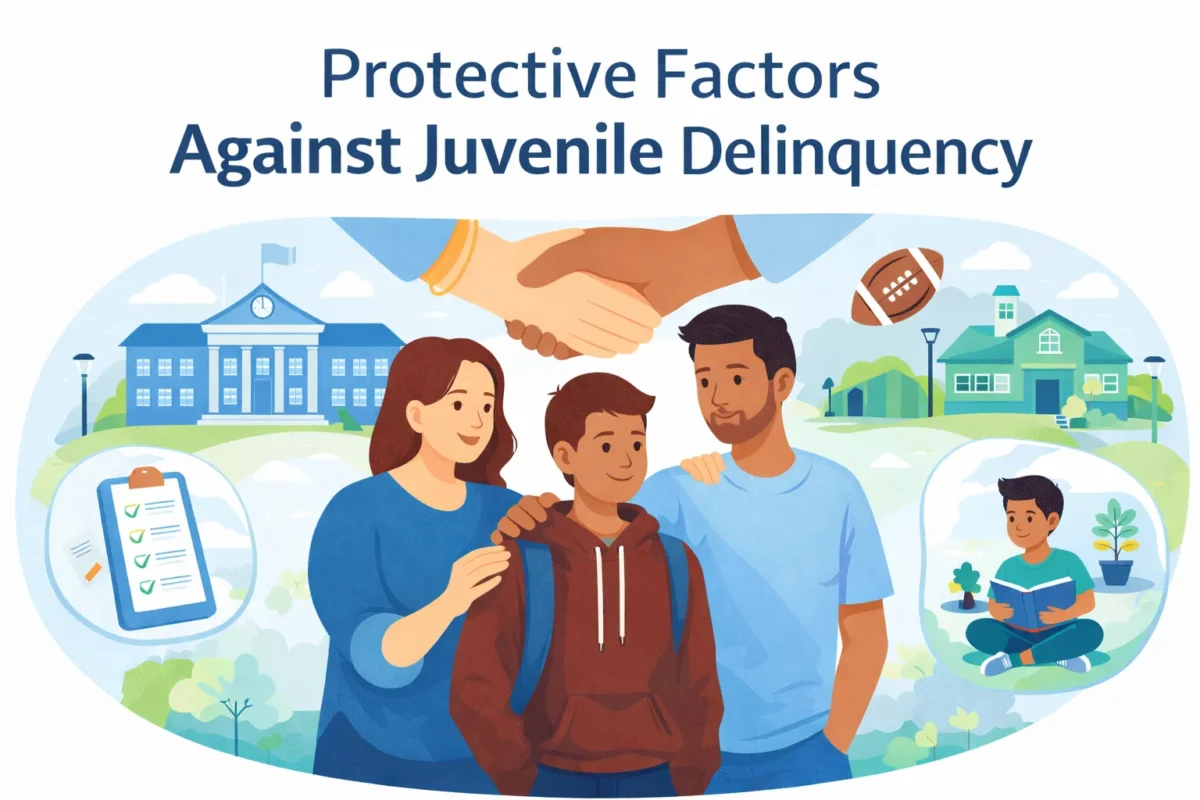
If you’re worried your teen might be heading down the wrong path, it’s easy to focus only on what could go wrong. But there’s good news: protective factors are the supports that make serious rule-breaking less likely even when stress, peer pressure, or tough situations are present. In this guide, you’ll learn protective factors against juvenile delinquency across five areas (individual, family, school, peers, and community) and get simple, practical steps you can start this week.
Quick Take (read this first)
- The biggest protection comes from layers: home + school + peers + community.
- You don’t need perfect parenting: consistent warmth + clear structure matters most.
- One trusted adult at school can be a powerful anchor.
- Prosocial friends and structured time reduce risky moments.
- Skills like self-control, problem-solving, and future goals lower impulsive choices.
- Community protection grows when youth have safe places, caring adults, and real opportunities.
- Start small: choose 2 domains, do 1 action each for 2 weeks, then add more.
If you’re unsure whether your child’s behavior is normal or concerning, start with our Juvenile Delinquency Warning Signs: Parent Checklist for Teens (and What to Do Next) for clear next steps.
What “Protective Factors” Means (plain English)
Protective factors are strengths and supports in a young person and in their environment that reduce the chance of harmful behavior. Think of them as buffers: skills, relationships, routines, and safe opportunities that help youth handle pressure, avoid bad situations, and stay connected to positive paths.
A key idea in prevention research is simple: the more healthy “assets” a young person has around them, the lower the risk, even when life is difficult.
Why This Matters for Delinquency Prevention
Delinquency does not come from one cause. It builds from many influences: the child, the family, the peer group, the school, and the wider community. That’s why prevention works best when it strengthens multiple protective layers, not just one. To understand what drives risky behavior in the first place, read Why Teens Break the Law: Root Causes of Juvenile Delinquency then come back here to build protection step by step.
The Five Protective-Factor Domains (quick map)
| Domain | What it includes |
|---|---|
| Individual | self-control, coping skills, decision-making, purpose |
| Family | bonding, warmth, routines, monitoring, stability |
| School | belonging, fair rules, achievement support, trusted adults |
| Peer | healthy friends, prosocial norms, positive role models |
| Community | safe spaces, mentoring, activities, opportunity and support |
1) Individual Protective Factors
These are skills and traits inside the young person that reduce impulsive decisions and increase healthy choices.
Common examples
- Self-control (pausing before reacting)
- Problem-solving (thinking through consequences)
- Communication (using words instead of aggression)
- Confidence/self-efficacy (“I can handle pressure”)
- Positive identity and future goals (“I have a reason to stay on track”)
What it looks like in real life
- A teen feels angry but walks away instead of fighting.
- A student uses a simple script: “No, I’m not doing that.”
- A child starts seeing themselves as someone who can improve.
Practical actions (parents/mentors)
- Teach a simple pause routine: Stop → Breathe → Name the feeling → Choose the next step.
- Build identity through small wins: attendance streaks, finishing a task, helping at home.
- Create an exit plan for risky moments: code word, pickup plan, safe friend, safe adult.
Practical actions (schools/youth programs)
- Do short weekly skill practice (10 minutes): conflict scripts, refusal skills, calming tools.
- Praise specific growth: “You handled that calmly,” not vague “good job.”
2) Family Protective Factors
Family protection is not about being strict or perfect. It’s about connection + structure that feels safe.
Core family protections
- Warmth, care, and emotional availability
- Clear rules (simple, memorable, consistent)
- Predictable consequences (not harsh, not random)
- Monitoring (knowing the who/where/when without spying)
- Stable routines (especially after school and evenings)
What it looks like in real life
- The caregiver knows where the teen is after school and checks in calmly.
- Rules are clear: “If you’re late, you call.” Consequences are consistent.
- After conflict, adults repair: “I got too loud. Let’s restart.”
Practical actions (parents/caregivers)
- Pick 3–5 rules tied to safety and respect. Post them. Repeat them.
- Add a daily 10-minute check-in (walk, tea, short drive, bedtime talk).
- Use supportive monitoring: meet other parents, know plans, keep communication open.
- Practice quick repair after mistakes: apology + calm redo.
3) School Protective Factors
School is one of the strongest daily protective environments because it can offer routine, belonging, and adult support.
Core school protections
- Feeling connected and noticed in a positive way
- Fair rules and predictable responses to behavior
- Support for learning (help early, not only punishment)
- Activities that create identity (clubs, sports, arts, leadership)
- At least one trusted adult at school
What it looks like in real life
- A student trusts one teacher, coach, or counselor.
- Teachers use consistent expectations, not public humiliation.
- The school recognizes effort and improvement, not only top grades.
Practical actions (educators/school leaders)
- Build a “one trusted adult” plan: each struggling student gets a connector who checks in weekly.
- Increase structured belonging: clubs, roles, service opportunities, team activities.
- Use calm, proactive classroom management (clear expectations + steady follow-through).
4) Peer Protective Factors
Peers matter a lot in adolescence. The goal is not isolation it’s access to healthier friends and norms.
Core peer protections
- Non-delinquent friends with positive goals
- Friend groups that support school, sports, work, hobbies
- Positive role models (older students, team captains, mentors)
What it looks like in real life
- A teen spends time with peers who value graduation or skill-building.
- Social time happens in structured places (practice, club, youth group, volunteering).
Practical actions (parents/caregivers)
- Ask better questions: “What do you like about them?” “What do you do together?”
- Make prosocial friendships easier: rides, snacks, safe hangout space, permission to invite friends over.
- Set limits with dignity: “I’m not okay with that situation,” and offer alternatives.
5) Community Protective Factors
Community protection is the “outside the home” support that helps youth stay engaged and supervised in healthy ways.
Core community protections
- Safe places (youth centers, libraries, sports grounds, faith/community spaces)
- Caring adults outside the family (coaches, mentors, neighbors, program staff)
- Opportunities: sports, arts, tutoring, skills training, part-time work, volunteering
- Positive community norms (celebrating growth, school milestones, service)
What it looks like in real life
- A teen has somewhere safe to go after school and adults who notice when they disappear.
- Youth have a real path to progress (skills, training, leadership roles).
Practical actions (community leaders/programs)
- Expand after-school options and remove barriers (cost, transport, timing).
- Keep staff stable (consistent adults build trust).
- Celebrate prosocial milestones publicly (attendance, service, graduation steps).
If gang involvement is a concern, Why Teens Join Gangs: 7 Key Reasons + Warning Signs explains what to watch for and how to respond early.
Putting It Together: A Simple 2-Week Plan
Big change usually starts with small consistency.
Step 1: Pick 2 domains to strengthen first
Common best start: Family + School
Step 2: Choose 1 action per domain
- Family: daily 10-minute check-in + clear after-school plan
- School: identify one trusted adult + weekly check-in
Step 3: Track tiny indicators
- fewer conflicts this week
- better attendance
- earlier bedtime
- one prosocial activity attended
Step 4: Add the next layer
Once the first two are stable, add peer or community supports.
Short Vignettes (how layering works)
Vignette 1: Marcus, 14 (family + school + peers)
After conflict at home, Marcus starts skipping class. A teacher becomes his weekly check-in adult. He joins a structured club where he meets peers focused on goals. At home, his caregiver adds a clear after-school routine and a daily 10-minute check-in. Over time, Marcus shows fewer absences because support is coming from multiple angles.
Vignette 2: Elena, 12 (individual + community)
Elena gets into frequent arguments. A youth program teaches a simple conflict script and pause skills. A community center gives her structured after-school time and steady adult support. With fewer unstructured hours and stronger coping tools, impulsive choices reduce.
Conclusion
When families, schools, and communities strengthen protective factors against juvenile delinquency, youth are more likely to stay connected to safe routines, supportive adults, and positive goals. For a bigger picture overview (including prevention ideas), see Juvenile Delinquency: Causes, Consequences, and Solutions.
FAQ
They are strengths and supports that reduce the chance of harmful behavior skills, stable relationships, routines, safe environments, and positive opportunities.
No. They reduce impact and improve odds. That’s why layering multiple supports matters.
Warmth + clear rules + consistent routines + calm monitoring. Even one daily check-in can help.
Because school offers daily structure and access to supportive adults. Feeling seen and supported can change choices.
No. Healthy friends are a protective factor. The goal is building access to better peer norms.
Start with one routine at home (after-school plan + check-in) and one school connection (trusted adult). Then add structured activities.