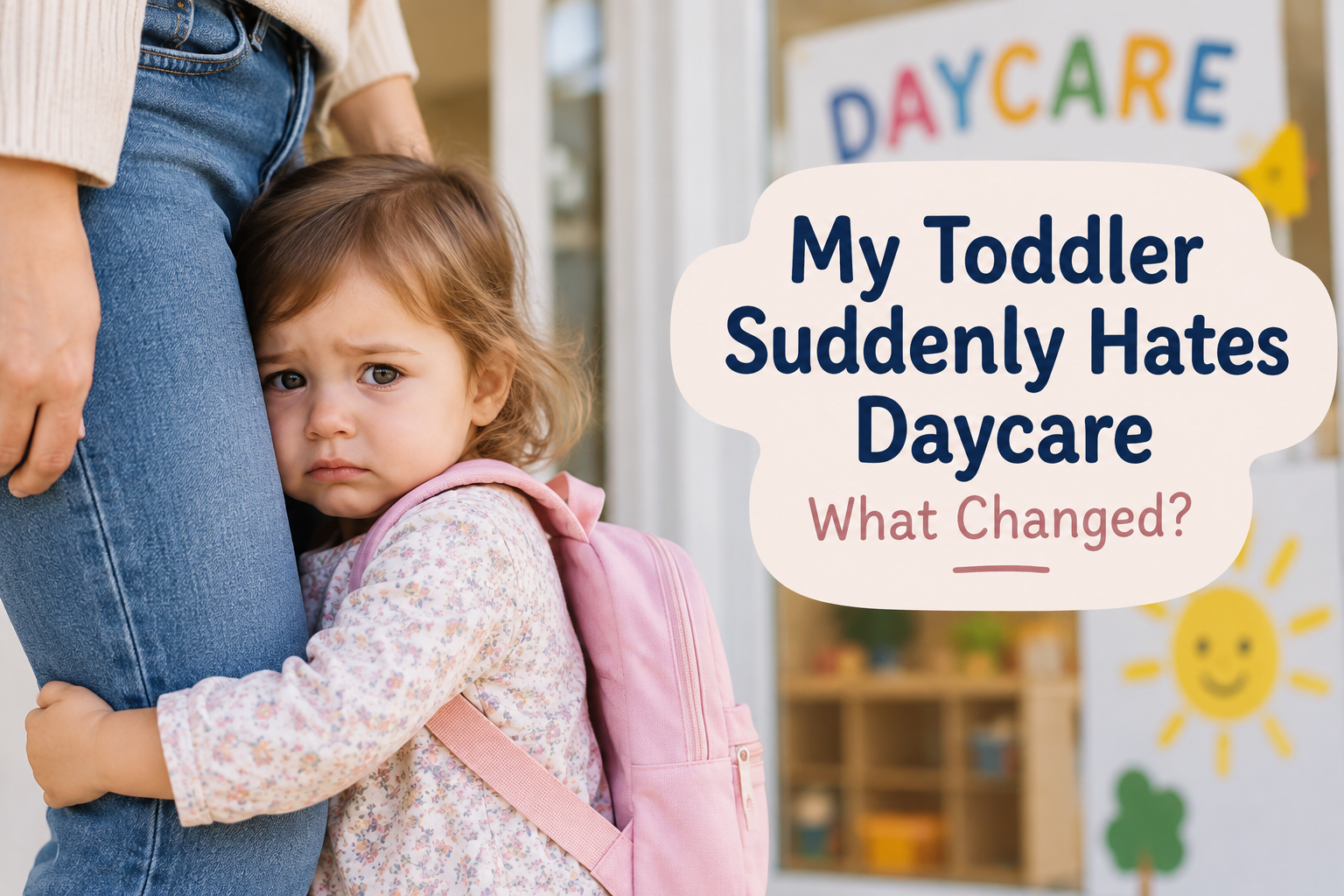
Your toddler used to walk into daycare happily. Maybe they waved goodbye, ran toward their toys, or barely looked back.
Then suddenly everything changed.
Now they cry before leaving home, hold onto your leg at the door, say they do not want to go, or become upset the moment daycare is mentioned.
When a toddler suddenly hates daycare after loving it, parents naturally wonder: Did something happen?
Sometimes something at daycare has changed. But sudden daycare refusal can also come from separation anxiety, tiredness, a developmental change, problems with another child, changes at home, or even a small event that felt much bigger to your toddler than it did to an adult.
The important thing is not to panic but also not to ignore a sudden change.
Here is how to work out what may be happening.
Quick Answer: Why Does My Toddler Suddenly Hate Daycare?
A toddler who suddenly refuses daycare may be reacting to:
- a new teacher or caregiver
- moving to another classroom
- separation anxiety returning
- conflict with another child
- being tired, hungry, sick, or overwhelmed
- a frightening or embarrassing experience
- changes happening at home
- returning after vacation or illness
- a daycare environment that no longer feels comfortable
One difficult drop-off does not tell you much.
A new pattern that continues or becomes stronger deserves closer attention.
1. Separation Anxiety Can Appear Again Even If Daycare Was Fine Before
Many parents assume separation anxiety only happens when a child first starts daycare.
It does not always work that way.
A toddler may have attended happily for months and then suddenly become much more aware of being separated from you.
As toddlers develop, they understand more about where you are going, how long you may be away, and that they cannot simply follow you.
This can make separation harder than it was when they were younger.
The American Academy of Pediatrics notes that separation can become particularly difficult during the toddler years and that tiredness, hunger and illness can make it worse.
Signs separation anxiety may be the cause
Your child may:
- cling mostly during drop-off
- become upset when you leave but settle later
- show similar clinginess when you leave them with relatives
- ask repeatedly whether you will come back
- become more attached to you at home
- struggle more after weekends, vacations or illness
A useful question for the daycare teacher is:
“How long are they upset after I leave?”
There is an important difference between a toddler who cries during the goodbye but then begins playing and a toddler who remains distressed for much of the day.
2. Something in the Daycare Routine May Have Changed
Adults sometimes say, “Nothing has changed.”
But from a toddler’s point of view, something small can completely change how daycare feels.
Think about the previous two or three weeks.
Has there been:
- a new teacher?
- a substitute caregiver?
- a classroom change?
- a new child in the group?
- a different nap routine?
- a new seating arrangement?
- a change in drop-off time?
- a favorite teacher who has been absent?
- a noisier classroom?
- toilet training pressure?
- a change in meals or snacks?
Children depend heavily on predictable routines.
A change that seems minor to an adult can make a young child feel that the familiar daycare they knew has disappeared.
Instead of asking the staff only:
“Has everything been okay?”
ask specific questions.
Try:
“Have there been any changes in teachers, children, routines, naps or activities recently?”
Specific questions are much more likely to uncover something useful.
3. Another Child May Be Making Daycare Difficult
Not every problem between toddlers is bullying.
Young children grab toys, push, shout, bite, exclude others and struggle with sharing because they are still learning social skills.
But repeated problems with one child can make your toddler start dreading daycare.
Your child may not be able to explain:
“Another child keeps taking my toy and pushing me during free play.”
Instead, they may simply say:
“I don’t like daycare.”
Look for clues.
Does your toddler suddenly mention one child’s name negatively?
Do they say someone is “mean”?
Do they become upset when a particular child arrives?
Have they started hitting, biting or using phrases you have not heard before?
Ask the caregiver how your child is interacting with the other children, particularly during less structured times such as free play, outdoor play and meals.
4. A Small Scary Event May Feel Huge to a Toddler
The event does not have to be serious to create fear.
Imagine daycare from the viewpoint of a two-year-old.
A fire alarm can be terrifying.
Being knocked over can feel enormous.
Having a toilet accident can feel humiliating.
A teacher raising their voice — even at someone else — may frighten a sensitive child.
Other possibilities include:
- vomiting at daycare
- a painful fall
- another child biting them
- getting locked outside a play group for a few moments
- a loud drill or alarm
- being unable to find their favorite caregiver
- waking from a bad dream during nap
- being frightened by another child’s behavior
Adults may forget the event by lunchtime.
Your toddler may connect the experience with the entire daycare.
That is why sudden behavior changes are worth investigating calmly.
5. Your Toddler May Simply Be Exhausted
Before assuming something serious happened, check the basics.
Toddlers behave very differently when they are:
- sleeping less
- waking earlier
- skipping naps
- teething
- recovering from illness
- hungry
- overstimulated
A toddler who normally tolerates separation may suddenly find it much harder when exhausted.
Look at what changed outside daycare as well.
Did bedtime become later?
Has your toddler started waking at night?
Did naps change?
Have mornings become rushed?
Sometimes the daycare refusal is not really about daycare. Daycare is simply the hardest transition of an already difficult morning.
6. Something May Have Changed at Home
Toddlers often show stress through behavior rather than words.
Changes at home can make children seek more closeness with their parents.
Possible triggers include:
- a new baby
- moving house
- one parent travelling
- a parent returning to work
- family conflict
- a new babysitter
- staying with relatives
- losing a pet
- changes in bedtime or morning routines
Even positive changes can affect a toddler.
Your child may not understand exactly what has changed. They may simply feel that life is less predictable and respond by resisting separation.
Extra connection at home can help.
That does not mean cancelling daycare immediately. It can mean giving your toddler more calm, focused time before and after daycare while keeping their routine predictable.
7. Returning After Illness or Vacation Can Cause Daycare Regression
One of the easiest patterns to miss is what happens after time away.
Your toddler may have been perfectly settled before:
- a family vacation
- Christmas holidays
- several sick days
- a long weekend
- visiting grandparents
After spending several days continuously with you, daycare separation can suddenly feel difficult again.
This does not necessarily mean your toddler has stopped liking daycare.
They may simply need time to reconnect with the routine.
Treat it almost like a smaller version of the original daycare transition.
Keep mornings predictable.
Talk positively but honestly about daycare.
And keep goodbye short.
8. Your Toddler May Be Testing Whether Refusing Changes the Plan
Toddlers are learning cause and effect.
They quickly discover that certain behaviors create certain responses.
If saying:
“I don’t want daycare!”
leads to twenty minutes of discussion, extra attention, delayed departure or occasionally staying home, the morning itself can become a negotiation.
This does not mean the child is pretending to be upset.
The emotion can be completely real while the response becomes reinforced by what happens afterward.
A calm routine is usually more useful than a long debate.
You can acknowledge the feeling without changing the boundary:
“You don’t want me to leave today. I know. Ms. Anna will look after you, and I will come back after afternoon snack.”
Then follow the same goodbye routine each day.
Predictability helps young children understand what happens next.
9. Sometimes You Do Need to Look More Closely at the Daycare
Most sudden daycare refusal does not automatically mean something harmful is happening. The quality of the childcare environment also matters, especially when your child’s behavior changes suddenly.
But parents should not explain away every change as separation anxiety either.
Pay closer attention if your toddler:
- seems frightened of one particular adult
- becomes extremely distressed before daycare every day
- remains upset for long periods after you leave
- has repeated unexplained injuries
- suddenly becomes fearful around changing, toileting or bathing
- has major sleep changes or frequent nightmares
- stops eating at daycare
- becomes unusually withdrawn
- shows strong regression that continues
- repeatedly tells you someone hurt, scared or threatened them
One sign alone does not prove that something serious occurred.
Look at the overall pattern.
If your child directly tells you that someone hurt or frightened them, stay calm and listen. Avoid repeatedly questioning them or suggesting answers.
Take what they say seriously and follow the appropriate safeguarding steps where you live.
The Most Useful Clue: When Does the Fear Start?
Instead of focusing only on the crying, pay attention to when the behavior changes.
If crying starts the night before
The child may be anticipating daycare or another separation.
If crying starts while getting dressed
The entire morning routine may now be associated with daycare.
If your toddler is happy until reaching the building
The difficult part may be the separation itself.
If your toddler becomes upset when a particular person appears
That is worth investigating more carefully.
If your toddler goes inside happily but is miserable at pickup
Look at what happens during the day rather than only the morning transition.
If Monday is terrible but Thursday is easy
The break in routine over the weekend may be contributing.
This simple timeline can tell you much more than asking:
“Do you like daycare?”
What NOT to Ask Your Toddler
Parents understandably want answers, but repeated or leading questions can confuse young children.
Avoid questions such as:
“Did your teacher shout at you?”
“Did somebody hurt you?”
“Is that boy being mean again?”
Unless the child has already told you something specific, start more openly.
Try:
“Tell me about daycare.”
“What happened after snack?”
“Who did you play with?”
“What was the hardest part today?”
“Show me with your toys what happened at daycare.”
Some toddlers communicate much more through play than direct questioning.
A Simple 7-Day Daycare Reset
If there are no immediate safety concerns, try making the next week extremely predictable.
Before daycare
Wake up with enough time to avoid rushing.
Use the same breakfast and getting-ready sequence where possible.
Tell your toddler what will happen:
“We are going to daycare. I will take you to your classroom. You will play, eat lunch and have your nap. I will come back after snack.”
At drop-off
Keep the goodbye loving but short. The American Academy of Pediatrics recommends using a short goodbye ritual and staying consistent with it from day to day.
Use the same simple ritual each day.
For example:
Hug.
Two kisses.
“Have fun. I love you. I’ll be back after snack.”
Then leave.
Do not secretly disappear. Your toddler needs to learn that goodbye means you are leaving — and that you reliably return.
During the day
Ask the daycare to observe:
- how quickly your child settles
- which activities they enjoy
- who they play with
- when they become upset
- whether eating or sleeping has changed
At pickup
Do not begin with twenty questions.
Reconnect first.
A hug, snack, drink and a quiet journey home may tell you more than questioning an exhausted toddler immediately.
Later, when they are relaxed, talk about their day.
What Should You Ask the Daycare?
Have a calm conversation rather than approaching staff as if something must already be wrong.
Useful questions include:
“This behavior is new. Have you noticed any change during the day?”
“How long do they remain upset after I leave?”
“Is there a particular part of the day they seem to dislike?”
“Have there been changes to staff or routine?”
“How are things going with the other children?”
“Have you noticed changes in eating, toileting or naps?”
“Is there anything that happened recently that might have frightened or embarrassed them?”
A good daycare should be willing to discuss patterns openly.
Should I Stop Sending My Toddler to Daycare?
Usually, one difficult week is not enough reason to immediately remove a child from daycare. A safe, consistent childcare environment should support your child’s emotional, social, and physical needs.
If the main problem is separation, suddenly stopping and restarting can sometimes make the routine less predictable.
Instead, first work out:
Is my toddler struggling with saying goodbye, or struggling with being at daycare?
Those are very different problems.
If your toddler cries when you leave but soon plays, eats, naps and interacts normally, the transition may be the main difficulty.
If your toddler remains distressed during the day, repeatedly asks to go home, stops participating or appears increasingly fearful, investigate further.
And if you have serious concerns about how your child is being treated, safety comes before maintaining a routine.
When Should I Talk to a Pediatrician?
Speak with your child’s healthcare professional if the anxiety becomes intense, continues to worsen, interferes significantly with normal daily life, or appears alongside concerning physical or emotional symptoms.
Professional advice can also help if you cannot tell whether the behavior is part of normal toddler development or something more significant.
Final Thoughts
When your toddler suddenly hates daycare after loving it, do not automatically assume either extreme.
It does not necessarily mean something terrible happened.
But it also should not automatically be dismissed as “just a phase.”
Become a detective rather than a worrier.
Look at what changed, when the fear begins, how long it lasts, what happens after you leave, and whether the pattern is improving or getting worse.
Talk to the daycare.
Listen to your child without putting words in their mouth.
Keep routines predictable.
And pay attention to patterns rather than one difficult morning.
Often, once parents identify what changed, the sudden daycare refusal starts making much more sense.
FAQs
A toddler may suddenly dislike daycare because separation anxiety has returned, a teacher or routine changed, another child is causing stress, they experienced something frightening, or changes at home have made separation harder. Look for what changed around the time the refusal began.
Sudden crying at daycare drop-off can happen even after months of easy separations. Developmental changes, tiredness, illness, vacations, changes in caregivers and increased awareness of separation can all contribute.
Temporary daycare refusal can happen during toddlerhood, especially after illness, holidays, developmental changes or changes in routine. What matters most is whether your child settles after you leave and whether the overall pattern improves.
Do not panic, but investigate the change. Ask daycare staff what has changed and observe your child’s behavior. Persistent distress, fear of a specific person, unexplained injuries or major behavioral changes deserve closer attention.
There is no single time limit that applies to every child. Ask the caregiver how quickly your toddler settles after you leave and what the rest of the day looks like. A brief difficult transition is different from distress that continues through much of the day.
Long goodbyes can sometimes make separation harder. A warm, predictable and brief goodbye is usually more helpful. Tell your child that you are leaving and when you will return in language they understand.
The difficult part may be separating from you rather than daycare itself. Ask caregivers how your child behaves after you leave. If they settle, play, eat and interact normally, the problem may mainly be the transition.
Consider looking more seriously at another childcare option if your child’s distress continues or worsens, they remain unhappy throughout the day, communication from the daycare is poor, you have unresolved safety concerns, or the environment no longer appears to meet your child’s needs.