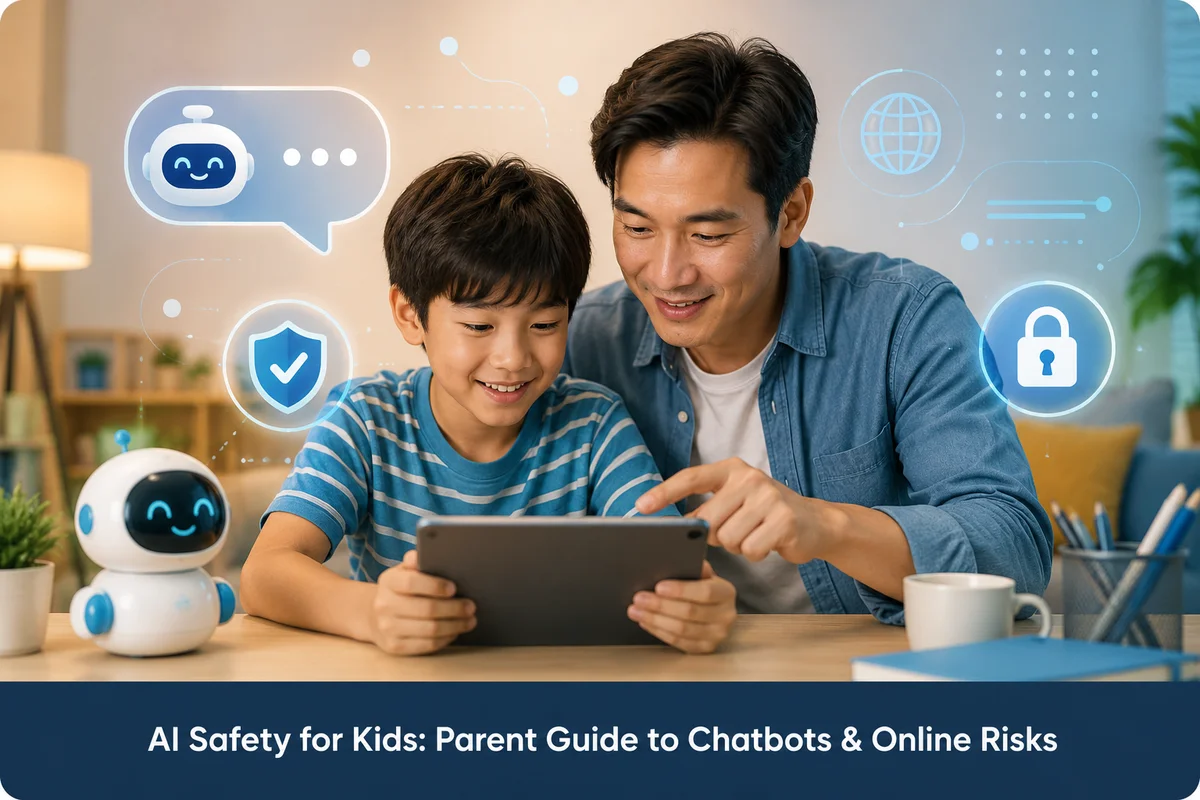
A few years ago, parents mostly worried about screen time, YouTube, gaming, and social media. Today, there is a new concern: artificial intelligence.
Children can now talk to AI chatbots, use AI homework tools, play with AI-powered toys, create AI images, and interact with apps that sound almost human. This can be useful, but it can also create new risks that many families are not ready for.
That is why AI safety for kids is becoming one of the most important parenting topics in 2026.
AI is not always bad. It can help children learn, write, draw, read, and solve problems. But parents need to understand one serious point: AI tools are not real people. They do not truly understand your child’s feelings, safety, age, or family values.
UNICEF has warned that AI systems can affect children’s rights, privacy, safety, and development if they are not designed and used carefully.
Parents do not need to panic. But they do need to pay attention.
For more general digital parenting, you may also read our guide on Parental Controls and Parenting.
What Is AI Safety for Kids?
AI safety for kids means helping children use artificial intelligence in a safe, healthy, and age-appropriate way.
It includes:
- protecting your child’s personal information
- checking which AI apps or toys they use
- teaching them that AI can be wrong
- stopping emotional dependence on AI chatbots
- avoiding unsafe AI image tools
- protecting children’s photos online
- setting rules for AI homework help
- keeping AI use open, not secret
The goal is not to ban every AI tool. The goal is to make sure your child uses AI with guidance, not blindly.
A simple way to explain it to children is:
“AI can help you, but it cannot replace your brain, your parents, your teachers, or your real friends.”
Why Parents Should Care About AI Safety in 2026
AI is no longer only for adults or tech experts. It is now inside apps, toys, school tools, search engines, games, and social platforms.
This matters because children are still developing judgment. They may believe what AI says because it sounds confident. They may share private information because the chatbot feels friendly. They may use AI to avoid thinking. Some may even start treating AI like a real friend.
Common Sense Media has warned that social AI companions can pose serious risks for children and teens, including inappropriate content, harmful guidance, and emotional dependence.
This is not just a future problem. It is already happening.
A child may ask AI:
- “Why does nobody like me?”
- “How do I lose weight fast?”
- “How do I hide something from my parents?”
- “Can you be my best friend?”
- “Can you write my homework?”
These questions may look simple, but the answers can affect your child’s thinking, confidence, safety, and emotional health.
If your child already uses social media, also read our guide on why parents should avoid secretly monitoring their kids’ social media. AI safety works best when parents build trust, not fear.
The Biggest AI Risks for Children
1. AI Chatbots Can Feel Too Real
Many AI chatbots are designed to sound friendly, calm, and personal. For adults, this may feel helpful. For children, it can become confusing.
A child may not fully understand that the chatbot has no real feelings. It may sound caring, but it is not actually caring. It may give advice, but it is not responsible for the result.
This becomes risky when children start sharing private emotions with AI instead of talking to parents, teachers, or trusted adults.
A child might say:
“The chatbot understands me better than anyone.”
That is a warning sign.
Parents should explain:
“AI can answer questions, but it cannot love you, protect you, or truly understand your feelings.”
Children need real human connection. AI should never become a replacement for family support, friendship, or emotional care.
2. AI Toys May Collect Private Information
AI-powered toys are becoming more common. Some toys can listen, speak, record, connect to Wi-Fi, and respond to children like a companion.
This may sound exciting, but it creates a serious privacy issue.
The FTC has taken action against a robot toy maker for allegedly allowing children’s data to be collected without proper parental consent.
Before buying any AI toy, parents should ask:
- Does this toy record my child’s voice?
- Does it connect to the internet?
- Does it store conversations?
- Can the company use my child’s data?
- Can I delete the data?
- Is there a clear privacy policy?
- Does it have parental controls?
If the company does not clearly answer these questions, do not buy the toy.
For younger children, simple toys, books, puzzles, blocks, pretend play, and outdoor play are often better than internet-connected “smart” toys.
You can also read our broader childcare guide here: Childcare Basics: Raise Happy, Confident Kids.
3. AI Can Give Wrong Answers With Confidence
One of the biggest problems with AI is that it can sound correct even when it is wrong.
This is dangerous for children because they may not question it. If an AI tool gives wrong advice about health, bullying, friendship, homework, religion, body image, or safety, a child may believe it.
Parents should teach this rule early:
“AI is a helper, not the final answer.”
For schoolwork, AI can help with ideas, examples, or explanations. But children should still think, write, check, and learn by themselves.
A good family rule is:
“Try first. Ask a human second. Use AI only as extra help.”
This protects your child’s learning and confidence.
4. AI Can Make Homework Too Easy
AI can write essays, solve math problems, summarize books, and answer questions in seconds. That sounds helpful, but it can also weaken a child’s effort.
Children learn by trying. They need to make mistakes, think slowly, correct themselves, and build patience.
If AI does everything, the child may submit work but learn very little.
Parents should not only ask:
“Did you finish your homework?”
They should ask:
“Can you explain how you did it?”
If the child cannot explain the work, AI may be doing too much.
A better rule is:
- AI can explain a topic.
- AI can give examples.
- AI can help check grammar.
- AI should not write the full answer for the child.
- AI should not replace real study.
This helps children use AI without becoming dependent on it.
5. Children’s Photos Can Be Misused Online
AI has changed the risk of posting children’s photos online. Photos can now be copied, edited, manipulated, or used in fake images and videos.
Parents should be careful with public posts, especially when the image shows a child’s face, school uniform, location, or routine.
Avoid posting:
- school names
- full names
- birth dates
- location tags
- daily routines
- bath photos
- emotional or embarrassing moments
- public albums of children’s faces
A simple safety rule is:
“Post less. Share privately. Remove location details.”
This does not mean parents can never post family moments. It means parents should post with more care than before.
Age-Wise AI Safety Rules for Parents
AI Safety for Children Under 5
Children under 5 should not use AI chatbots alone. At this age, children cannot understand the difference between a real person and a machine that talks like a person.
Best rules for this age:
- avoid AI companion toys
- avoid private chatbot use
- avoid voice chatbots
- use only parent-controlled learning apps
- keep screens limited
- choose real play over AI interaction
For young children, real conversation matters most. Talking with parents, siblings, teachers, and caregivers supports language, bonding, and emotional growth.
AI Safety for Children Aged 6 to 12
Children in this age group may use AI for learning, stories, spelling, reading, or creative ideas. But they still need close supervision.
Best rules:
- use AI only in shared family spaces
- do not allow secret AI accounts
- do not share name, school, address, photos, or phone number
- do not ask AI about private family problems
- check important answers with a parent or teacher
- set time limits
- keep AI away from bedtime
Use this simple sentence:
“You can ask AI for help, but you cannot tell AI private things.”
If your child is starting to use social platforms, you may also like this guide: Social Media Rules Contract for Tweens.
AI Safety for Teenagers
Teenagers may use AI for studying, writing, coding, image creation, entertainment, or emotional support. They need guidance, not only restrictions.
Best rules for teens:
- talk openly about AI companions
- explain that AI is not therapy
- discuss deepfake and image privacy risks
- set clear schoolwork rules
- teach them to fact-check AI answers
- warn them not to share private photos
- encourage real friendships and hobbies
Do not simply say:
“Never use AI.”
That may make your teen hide it.
A better approach is:
“Use AI wisely, but do not let it replace your judgment, privacy, or real relationships.”
Teenagers respond better when they feel respected. Clear boundaries work better than silent spying.
Warning Signs Your Child May Be Too Attached to AI
Parents should watch for these signs:
- your child talks to AI for long periods every day
- they hide AI conversations
- they prefer AI over real friends
- they ask AI for emotional advice often
- they believe AI truly understands them
- they get angry when AI access is removed
- they use AI to avoid homework effort
- they share private family details with AI
- they seem more withdrawn from real people
One sign does not always mean there is a serious problem. But if several signs appear together, parents should act calmly.
Do not shame the child. Say:
“I’m not angry. I just want to understand how you are using this.”
That sentence keeps the conversation open.
How Parents Can Protect Kids from AI Risks
1. Make AI Use Visible
Children should not use AI secretly.
Keep AI use in open spaces, especially for younger children. Let them ask questions with you nearby. Check what tools they are using and why.
The aim is not to control every click. The aim is to make AI a normal family conversation.
Ask simple questions:
- What app is this?
- Why do you use it?
- What does it help you with?
- Did it ever say something strange?
- Do you know what not to share?
These questions help parents catch problems early.
2. Set Clear Family AI Rules
Your family AI rules should be short and easy to remember.
Use rules like:
- Do not share private information with AI.
- Do not upload personal photos without asking.
- Do not use AI secretly.
- Do not believe every AI answer.
- Do not use AI as a therapist.
- Do not let AI do all your homework.
- Tell a parent if AI says something scary, rude, sexual, or strange.
Rules work better when children understand the reason behind them.
Instead of saying:
“Because I said so.”
Say:
“Because your information, photos, and feelings are valuable.”
3. Teach Children What Private Information Means
Many children think private information only means passwords. That is not enough.
Private information includes:
- full name
- school name
- home address
- phone number
- email address
- photos
- voice recordings
- location
- family problems
- medical details
- passwords
- daily routine
Teach your child:
“If you would not tell a stranger outside, do not tell an AI chatbot.”
This is one of the simplest and strongest AI safety lessons.
4. Keep AI Away from Bedtime
Bedtime is when children may feel lonely, emotional, or more likely to overshare. That makes late-night AI chatbot use risky.
Children and teens may start asking AI personal questions at night, especially if they feel stressed, rejected, or anxious.
Parents should keep bedrooms screen-free when possible. At minimum, set a rule that AI apps are not used after bedtime.
Good bedtime habits still matter:
- no AI chats late at night
- no phones under the pillow
- no secret screen use
- no emotional dependence on chatbots
- more reading, calm talk, and sleep routine
Healthy sleep protects mood, learning, and behavior.
5. Check AI Tools Before Your Child Uses Them
Before allowing any AI app, toy, or chatbot, parents should check:
- Is it made for children?
- What age does it allow?
- Does it collect data?
- Does it save chat history?
- Can strangers contact the child?
- Can the child upload photos?
- Are parental controls available?
- Can the account be deleted?
- Is the privacy policy clear?
If an app is made for adults, do not treat it as safe for children just because it looks friendly.
Many adult AI tools are not designed around child development, child privacy, or child safety.
6. Talk About AI Images and Deepfakes
Children and teens need to understand that not every image or video online is real.
AI can create fake faces, fake voices, fake photos, and fake videos. This can be used for jokes, but it can also be used for bullying, embarrassment, scams, or harassment.
Tell your child:
“Never use AI to make fake images of another person. And if someone makes a fake image of you, tell me immediately.”
This is especially important for teens because image-based bullying can spread quickly.
If your child is facing online cruelty, also read: Cyberbullying in Schools: Prevention and Intervention Strategies.
Should Parents Ban AI Completely?
For most families, a complete ban is not realistic. AI is already becoming part of school, search, apps, games, and creative tools.
A total ban may also make children more curious and secretive.
A better approach is guided use.
This means parents should:
- explain AI in simple words
- use AI with the child first
- set rules before problems happen
- keep private information protected
- teach children to question AI answers
- watch for emotional dependence
- stay involved without spying too much
Children who understand AI are safer than children who use it secretly.
What Parents Should Say to Kids About AI
Here are simple lines parents can use:
For young children:
“AI is a computer helper. It is not a real person.”
For school-age children:
“AI can help with ideas, but you must not tell it private things.”
For teens:
“AI can be useful, but it should not replace your judgment, your privacy, or real relationships.”
For homework:
“Use AI to understand, not to cheat.”
For emotional problems:
“If something feels serious, scary, or personal, talk to a real person.”
These short lines are easy for children to remember.
Final Thoughts: AI Safety Is Now Part of Modern Parenting
AI safety for kids is not about fear. It is about preparation.
Parents do not need to become technology experts. They need to stay involved, ask better questions, and teach children simple safety rules.
The best approach is balanced:
- do not panic
- do not ignore AI
- do not allow secret use
- do not trust every tool
- do not let AI replace real connection
AI can help children learn and create, but it should never replace family, friendship, effort, privacy, or emotional support.
Childhood is changing. Parenting has to change with it.
The safest children will not be the ones who never see AI. They will be the ones who understand how to use it carefully.
FAQs About AI Safety for Kids
AI can be safe for kids when parents choose age-appropriate tools, supervise use, protect privacy, and teach children not to trust every AI answer. It becomes risky when children use AI secretly, share personal details, or depend on chatbots emotionally.
Young children should not use AI chatbots alone. Older children and teens can use AI tools for learning or creativity, but parents should set clear rules and check the tool first.
Some AI toys may be useful, but parents should be careful. Any toy that records voice, connects to Wi-Fi, stores conversations, or collects child data should be checked carefully before purchase.
Kids should never tell AI their full name, school name, address, phone number, passwords, location, private photos, family problems, or emotional secrets.
Yes, AI can help explain topics, give examples, and support learning. But children should not use AI to write full answers or avoid thinking. AI should support learning, not replace it.
Parents can protect children by setting clear AI rules, using AI tools together first, checking privacy settings, limiting bedtime use, avoiding unsafe AI toys, and teaching children that AI can make mistakes.